
Agentic Workflows: How EventAIx Cuts Event Planning Time by 80%
The Power of Agentic Workflows: How EventAIx Reduces Event Planning Time by 80%
Event planning has always been a balancing act. Coordinating venues, vendors, speakers, timelines, budgets, and attendee communications can quickly turn into a full-time operational burden. For planners, agencies, and in-house teams, the challenge is not just doing the work well—it is doing it fast enough to keep up with client expectations.
That is where agentic workflows are changing the game.
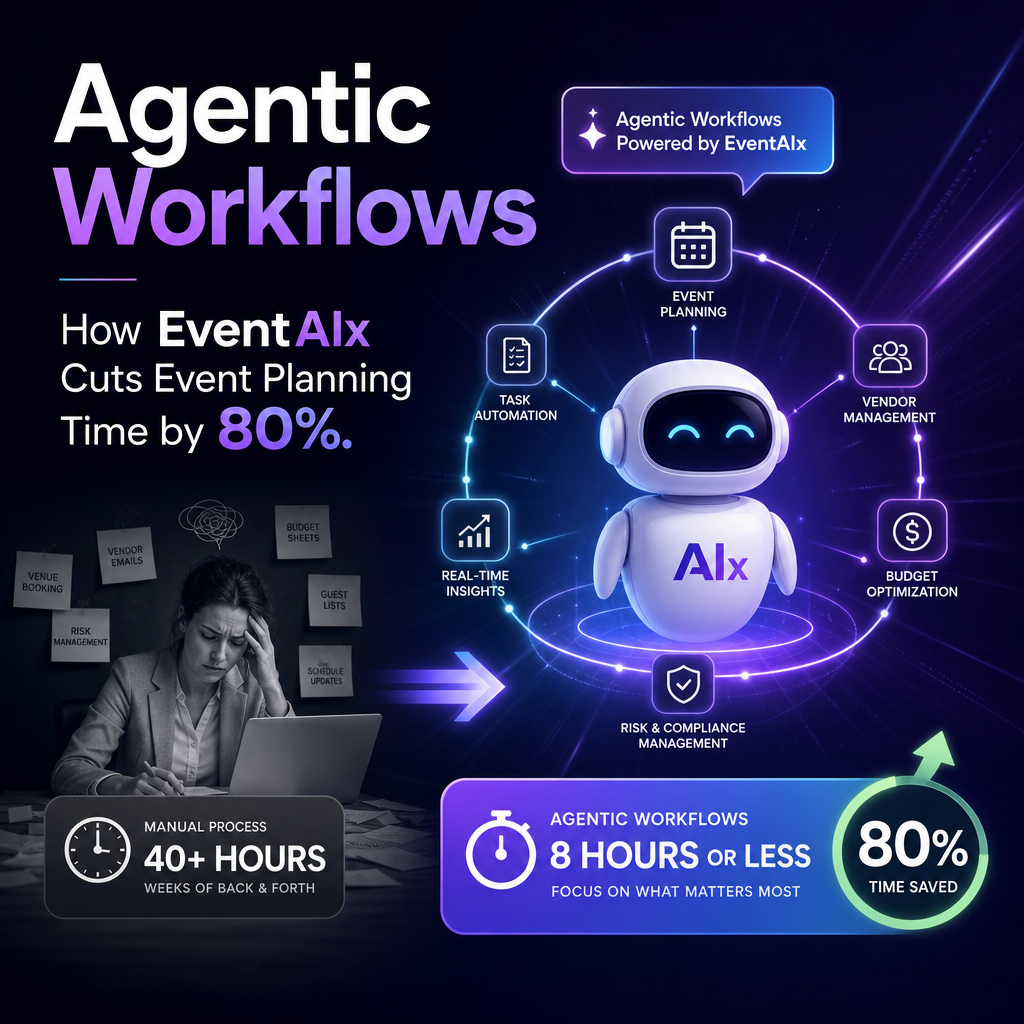
Instead of relying on manual coordination at every step, agentic systems use AI agents to execute tasks, make decisions within defined rules, and move work forward with minimal human intervention. EventAIx is one example of this shift in action. By automating complex planning tasks, it helps teams reduce event planning time by as much as 80%.
What Are Agentic Workflows?
Agentic workflows are AI-powered processes where intelligent agents take on parts of a job traditionally handled by people. Unlike simple automation, which only follows fixed rules, agentic workflows can adapt to context, choose next steps, and work across multiple tools.
In event planning, this means AI can help with tasks like:
- Gathering event requirements
- Drafting timelines and task lists
- Researching venues and vendors
- Coordinating schedules
- Sending reminders and follow-ups
- Monitoring changes and updating plans
The result is a workflow that feels less like pushing paperwork and more like having a tireless assistant that never loses track of details.
Why Event Planning Takes So Much Time
Event planning is time-consuming because it is full of repetitive, high-stakes decisions. A single event may require hundreds of small actions, each dependent on the last.
Some of the biggest time drains include:
1. Manual information gathering
Planners often start by collecting details from clients, stakeholders, and attendees. This information is usually scattered across emails, forms, meetings, and spreadsheets.
2. Vendor coordination
Comparing quotes, checking availability, and negotiating with vendors can take hours or days.
3. Timeline management
Every moving part must stay aligned. A delay in one area can affect the entire event schedule.
4. Communication overload
Teams spend large amounts of time answering the same questions, sending updates, and chasing approvals.
5. Last-minute changes
Events are dynamic. A speaker cancels, a venue changes rules, or attendance spikes unexpectedly. Responding quickly is essential.
This is exactly the kind of environment where agentic workflows shine.
How EventAIx Changes the Workflow
EventAIx uses AI agents to handle the repetitive and operational parts of event planning. Instead of forcing planners to start from scratch, it creates a smarter system that can move from input to execution much faster.
Smarter intake and planning
EventAIx can quickly transform raw event requirements into structured plans. A planner provides the basics—event type, goals, audience, budget, and date—and the platform helps generate a clear planning framework.
This cuts down on the time usually spent building schedules, assigning tasks, and deciding next steps.
Automated research and coordination
Finding the right venue or vendor often involves comparing dozens of options. EventAIx can help streamline that research by sorting through criteria, identifying matches, and organizing options for review.
That means teams spend less time searching and more time making informed decisions.
Continuous task movement
One of the most valuable features of agentic workflows is momentum. Instead of waiting for a human to manually trigger every step, the system can progress tasks automatically when conditions are met.
For example:
- Once a venue is confirmed, related tasks can be created instantly
- After a speaker is approved, communication templates can be prepared
- When a deadline approaches, reminders can be sent automatically
This keeps projects moving without constant oversight.
Better communication management
EventAIx also helps reduce the communication burden. By generating updates, drafts, and follow-up messages, it removes much of the back-and-forth that slows teams down.
The human team still stays in control, but they no longer have to write every message from scratch.
How 80% Time Savings Add Up
Reducing event planning time by 80% is not just about speed. It is about removing friction from every stage of the process.
Here is where the savings come from:
- Less manual data entry
- Faster first-draft planning
- Reduced vendor and venue research time
- Automated task creation and tracking
- Streamlined communication
- Fewer delays caused by missed follow-ups
When each of these improvements compounds, the total time savings become significant.
A task that once took 10 hours may now take 2. A planning cycle that used to stretch across weeks can move in days. For teams managing multiple events, that difference is enormous.
The Human Role Still Matters
Even with powerful agentic workflows, event planning is not being replaced—it is being enhanced.
AI handles the repetitive and operational work, while humans focus on the parts that require creativity, judgment, and relationship-building. That includes:
- Designing memorable experiences
- Managing stakeholder expectations
- Making strategic decisions
- Handling complex negotiations
- Solving unexpected problems
This combination of AI efficiency and human expertise is what makes platforms like EventAIx so effective.
The Future of Event Planning
The future of event planning will belong to teams that can move quickly without sacrificing quality. Agentic workflows make that possible by turning planning into a more intelligent, responsive, and scalable process.
EventAIx shows how this can work in practice. By reducing event planning time by 80%, it gives teams back their most valuable resource: time. That time can then be used to build better events, stronger relationships, and more meaningful attendee experiences.
In a field where timing is everything, that is a powerful advantage.