
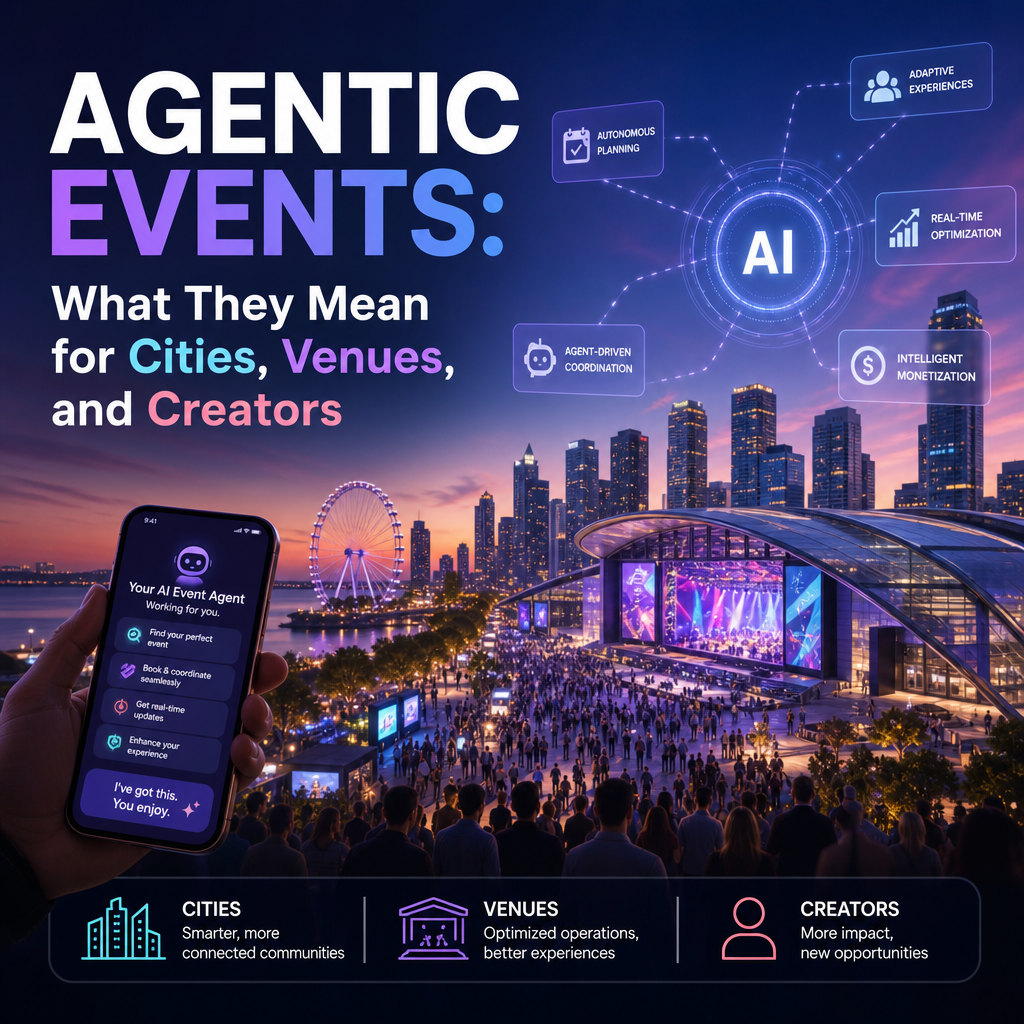
Agentic Events: What They Mean for Cities, Venues, and Creators
The Rise of Agentic Events: What It Means for Cities, Venues, and Creators
The events industry is entering a new phase. For years, cities, venues, and creators have focused on making live experiences more digital, more interactive, and more scalable. Now a new idea is emerging: agentic events.
At a high level, agentic events are experiences shaped by autonomous systems that can take action, make decisions, and personalize the event journey in real time. Instead of treating attendees as one large audience, these events respond to people individually, adjusting schedules, recommendations, content, and logistics as things unfold.
That shift is more than a tech upgrade. It could change how events are planned, sold, hosted, and remembered.
What Are Agentic Events?
Agentic events use intelligent systems that do more than automate simple tasks. They can interpret data, anticipate needs, and act on behalf of organizers or attendees.
That might look like:
- A city-wide festival app that reroutes visitors based on crowd levels
- A venue system that adjusts entry flows when congestion builds
- A creator-led conference that adapts sessions based on live audience interest
- A virtual assistant that helps attendees build a personalized agenda
The key difference is responsiveness. Agentic systems are not just programmed once and left alone. They react to behavior, context, and changing conditions.
Why This Matters Now
The growth of agentic events is being driven by several trends at once.
1. Audiences expect personalization
People are used to algorithms recommending what to watch, buy, and read. They increasingly expect the same from live events.
If an attendee can get a custom playlist, custom travel route, and custom shopping experience elsewhere, a one-size-fits-all event feels outdated.
2. Cities want smarter crowd management
Large events can strain transit, public safety, and local businesses. Agentic systems can help cities manage these pressures more dynamically by:
- Monitoring traffic and footfall
- Suggesting alternate routes
- Balancing visitor flow across neighborhoods
- Sharing real-time updates with residents and guests
This makes events easier to host at scale without overwhelming urban infrastructure.
3. Venues need better efficiency
Venues operate under constant pressure to do more with less. Staffing shortages, rising costs, and higher attendee expectations make efficiency essential.
Agentic tools can support:
- Smarter scheduling
- Better queue management
- Energy optimization
- Predictive maintenance
- Personalized wayfinding
That can reduce friction for guests while helping venues run more smoothly behind the scenes.
What It Means for Cities
For cities, agentic events are about more than convenience. They are a chance to turn major gatherings into coordinated systems rather than isolated disruptions.
Better visitor distribution
When thousands of people attend concerts, conventions, or festivals, the biggest challenge is often not the event itself but what happens around it. Hotels, restaurants, transit hubs, and neighborhoods all feel the impact.
Agentic systems can help spread demand by suggesting nearby attractions, off-peak visits, and alternate destinations.
Stronger local economic impact
A smarter event ecosystem can direct people toward smaller businesses, side events, and local experiences that might otherwise be overlooked. That means more revenue can stay within the city.
More responsive public planning
When cities have access to live event data, they can make better decisions about staffing, transit, cleanup, and emergency response. Over time, that makes large events less risky and more sustainable.
What It Means for Venues
Venues may be the most immediate beneficiaries of this shift. Agentic events can make a physical space feel more fluid, more intelligent, and more visitor-friendly.
Faster, smoother experiences
No one likes long lines, confusion, or missed sessions. Agentic tools can help guests move through a venue with less stress by:
- Sending live directions
- Updating check-in instructions
- Recommending less crowded entrances
- Alerting guests when sessions are about to fill up
More adaptive programming
A venue with real-time audience insight can react faster. If one session is packed and another is underfilled, the system can suggest changes immediately. That kind of flexibility creates better attendance balance and higher satisfaction.
New revenue opportunities
Smarter event flows can also improve merchandising, food service, and sponsorship activations. If a system knows where attention is concentrated, it can surface the right offers at the right time.
What It Means for Creators
Creators are not being replaced by agentic events. If anything, they may gain more control over how audiences experience their work.
More time for originality
By handling repetitive tasks like scheduling, routing, and basic attendee support, intelligent systems give creators more time to focus on content and storytelling.
Deeper audience connection
Creators can use agentic tools to understand what different audience segments want and adjust programming accordingly. That might mean offering multiple content tracks, surprise moments, or tailored follow-ups after the event.
New formats for engagement
Agentic events open the door to experiences that feel more interactive and alive. A creator can design an event that changes in response to audience mood, participation, or even live feedback from the room.
That creates a more memorable experience and a stronger sense of participation.
The Challenges Ahead
Of course, agentic events also raise important questions.
Privacy, transparency, and data security will matter more than ever. If systems are making decisions in real time, organizers need to be clear about what data is being used and how.
There is also the risk of over-automation. Events still need human judgment, creativity, and hospitality. The best use of agentic tools will be to support people, not replace them.
A Smarter Future for Live Experiences
The rise of agentic events suggests a future where live experiences are more adaptive, efficient, and personal. Cities can manage crowds more intelligently. Venues can operate more smoothly. Creators can build richer and more responsive experiences.
In other words, events are no longer just something people attend. They are becoming systems that can sense, respond, and evolve in real time.
That is a major shift, and it may define the next era of live experiences.